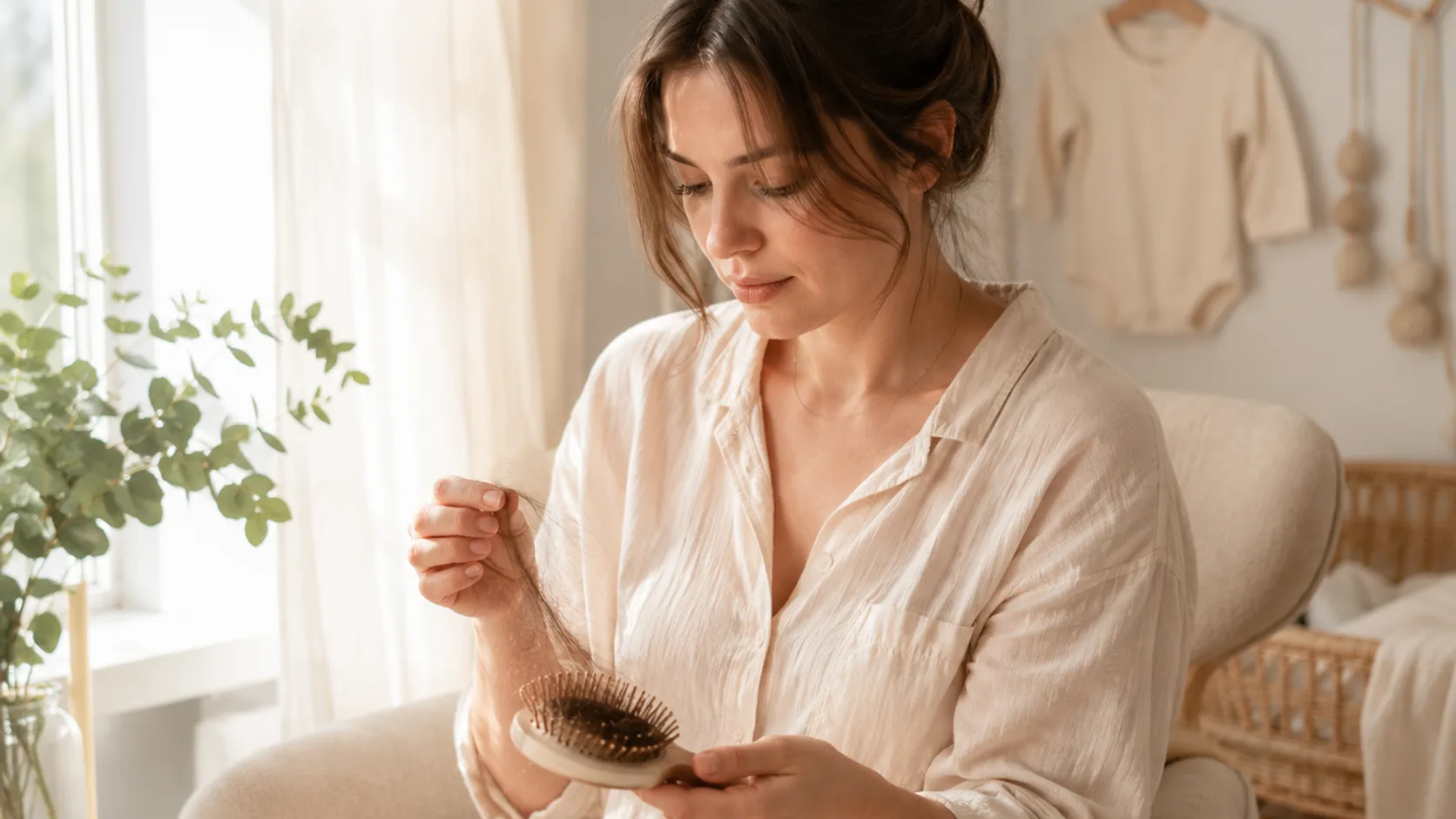

You notice it first in a certain light, or in a holiday photo: the part wider than it used to be. Then hair stays on the brush, though you've changed nothing. The first thought is usually the same — "well, age." And that's the most common mistake in the whole story.
Because your hair didn't grow old. It lost its protection.
For most of your life, estrogen worked like a bodyguard for the hair follicle: it lengthened the growth phase, kept androgens in check, and made sure the hair stayed thick and hydrated. In menopause that bodyguard steps off stage — and the androgens you've carried all along get a free hand. The result shows on two levels at once: there's less hair, and each strand is weaker.
This piece explains both levels, separates what can be reversed from what can't, and shows plainly what actually works — including where a cosmetic's role ends.
Two changes, not one
Here's the first thing to grasp: menopause doesn't do one thing to hair, it does two different things. Confusing them ends in buying the wrong solutions.
The follicle shrinks. Without estrogen the growth phase shortens, and androgens begin to miniaturize the follicles step by step — a thick hair becomes thinner and thinner, down to a barely visible vellus fuzz. So it isn't "a handful and done": hair after hair grows finer, and the head of hair quietly loses density. This is female pattern hair loss (FPHL), far more common after menopause, and it has a characteristic pattern — diffuse thinning on the crown and along the part, with the frontal hairline usually preserved.
The hair itself changes too. Even the strands that stay are different to the touch: finer, a changed texture, more matte and brittle. Less estrogen also means less sebum, so the hair holds water less well. Hence the line heard almost daily in the clinic: "it's dry as straw, and I haven't changed a thing."
One thing to remember: sparser hair and weaker hair are two separate problems — and each needs a different answer.
It follows a pattern — which is why it isn't "just age"
If age alone were the cause, hair would thin evenly, across the whole head. Menopausal loss doesn't look like that: it's diffuse, but heaviest on the crown and along the part. That pattern is the signature of androgens acting on a follicle that estrogen has stopped protecting — not the signature of a calendar.
That's both bad news and good. The bad: no cosmetic reverses miniaturization. The good: since this is a hormonal process with a known mechanism, it also has a real handle for treatment — provided it's identified.
And no, you're not "overreacting." Losing density in menopause can hit self-esteem hard, and that's documented, not imagined. All the more reason to deal with it methodically rather than wait for it to "pass on its own."
Diagnosis first, not a cosmetic
Order matters here more than the choice of product.
Check that it really is menopausal hormones. An underactive thyroid, low ferritin (iron stores) and vitamin D deficiency look a lot like FPHL — and they're common and reversible. Basic blood work settles it quickly.
With confirmed pattern hair loss — treatment, not care alone. A trichologist or dermatologist sets the plan; the standard remains topical minoxidil. Menopause can also trigger temporary telogen effluvium — the same mechanism we described in stress-related shedding — and, less often, frontal fibrosing alopecia, which needs a prompt visit, because scarring is irreversible.
Hormone therapy (HRT) is not a hair treatment. Since the problem is falling estrogen, it's tempting to "fix it with hormones." But studies of HRT for hair loss are inconsistent, and some even link it with a higher risk of scarring alopecia. HRT can be a good health decision — but you discuss it with a gynecologist for the whole picture, not as a density fix.
What you actually do for the hair you have
This is where a cosmetic makes sense — as long as you know what to expect from it. It won't reverse hormones. It will do exactly what menopausal hair needs on that second front: rebuild its condition and limit breakage, and give a dried-out scalp some comfort.
But before you reach for a jar, two things do more than any product:
- Treat the hair as fragile — because it has become fragile. Menopausal hair breaks more easily, so: less flat-iron and hot dryer, more care with ammonia dyes, detangle from the ends, loose styles instead of tight ones. This isn't "growing" new hair — it's not losing, mechanically, the hair you have.
- Cover the basics from within. Hair is largely protein; deficiencies (iron especially) and chronic stress worsen every kind of shedding. Sleep and a balanced plate are the backdrop on which everything else works better.
Which product for menopause — and why the mask
Now to specifics, because this is what you ask most. Our three products aren't the same — they're built for different jobs, and menopausal hair has clear priorities.
The mask is dense emollients — jojoba, sweet almond and hemp oils, shea butter — plus hydrolyzed silk and colostrum. It answers directly what menopause does to the hair itself: dryness, dullness, brittleness, "won't behave." It rebuilds softness and smoothness in the lengths and limits breakage. If I had to name one product for menopause, it would be the mask — because dryness and fragility touch almost every woman in this period.
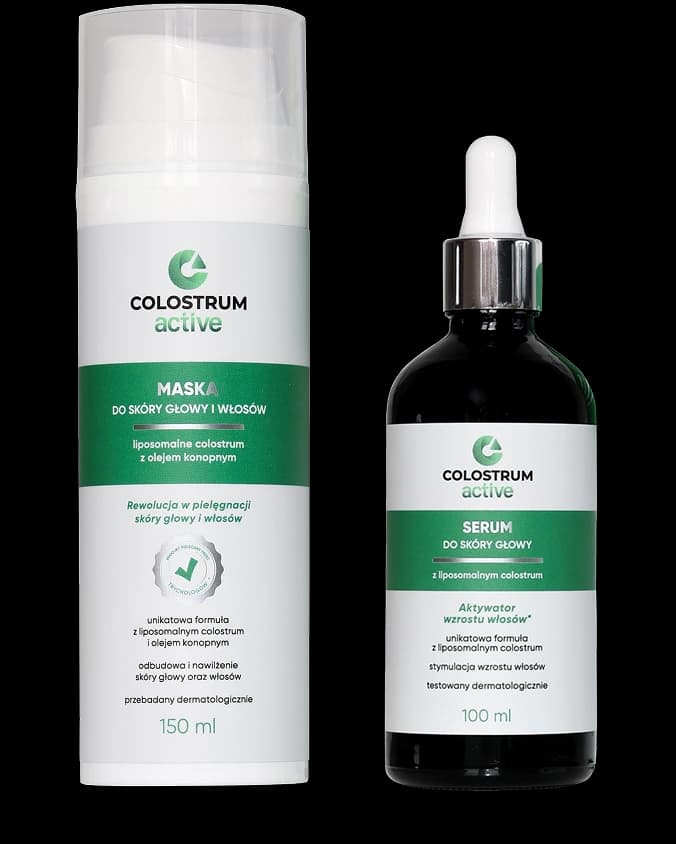
The serum works on another level — the scalp. It pairs liposomal colostrum with a complete ceramide-barrier complex (Ceramide NP/AP/EOP, phytosphingosine, cholesterol) that rebuilds the barrier of a thinner, drier menopausal scalp. Support for the follicle's environment and skin comfort — not a "loss cure," but concrete help where the skin turns more sensitive.
The set is both levels at once: serum on the scalp, mask on the lengths. If the problem is twofold — and in menopause it usually is — that's the most complete answer.
In short: hair condition → the mask; scalp → the serum; both → the set. And not for a moment am I offering it as a way to fix hormones. It's good care for hair that menopause has changed — that's exactly what I promise, no more.
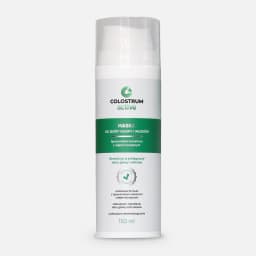
Colostrum Active mask with liposomal colostrum
Intensive regenerating mask.
Frequently Asked Questions
Does menopause cause hair loss?
Yes, for many women. Falling estrogen with a relative rise in androgens shortens the growth phase and favours follicle miniaturization — female pattern hair loss (FPHL), which is more common after menopause. Menopause can also trigger temporary telogen effluvium. Still, it's worth first ruling out other, reversible causes: thyroid, ferritin and vitamin D.
Why does hair get thin and dry in menopause?
Because estrogen affects not just how many hairs grow, but the hair itself. After it drops, hairs have a smaller diameter, a changed texture, and are more matte and brittle. Less sebum means the hair holds water less well — hence the dryness despite an unchanged routine.
Will hair grow back after menopause?
It depends on the cause. Temporary telogen effluvium usually reverses once the trigger passes. Female pattern hair loss, however, is a progressive process — it doesn't "regrow" on its own, but it can be slowed and density improved under specialist care. Early diagnosis is key: the sooner, the more you can keep.
Does hormone therapy (HRT) help hair?
It isn't a hair treatment. Studies of estrogen for menopausal hair loss are inconsistent, and some data even link HRT with a higher risk of frontal fibrosing alopecia. HRT may make sense for other health reasons — decide with your gynecologist, without expecting it to rebuild density on its own.
How should I care for hair in menopause?
Treat it as delicate: cut back on the flat iron and hot dryer, go easy on ammonia dyes, detangle gently from the ends, choose loose styles. Hydrate the lengths and look after scalp comfort, and from within, mind your protein, iron and sleep. It won't change hormones, but you'll lose less hair mechanically, and what you have will be stronger.
When should I see a trichologist or dermatologist?
When thinning clearly progresses, you see a widening part, smooth patches without hair or a receding frontal line, or when shedding won't ease despite good care. A trichoscopy and basic blood work are the starting point — the earlier, the better the outlook.
In closing
Menopausal hair doesn't age passively — it reacts to estrogen's departure, on two levels: there's less of it, and it's weaker. The first is handled by diagnosis and treatment with a specialist; the second, by calm, sensible care.
I won't promise that a cosmetic restores hormones, because it doesn't. I promise something more honest: that once you understand what really left — protection, not youth — you'll stop fighting the wrong opponent and start doing what works for the hair you have. If you'd like to see how calm, consistent care translates into results, we've gathered real stories from our clients.
Sources
This article draws on peer-reviewed scientific publications (data from PubMed):
- Gupta AK, Economopoulos V, Mann A, Wang T, Mirmirani P. (2025) — Menopause and hair loss in women: Exploring the hormonal transition. Maturitas 198:108378. DOI: 10.1016/j.maturitas.2025.108378
- Kamp E, Ashraf M, Musbahi E, DeGiovanni C. (2022) — Menopause, skin and common dermatoses. Part 1: hair disorders. Clinical and Experimental Dermatology 47(12):2110–2116. DOI: 10.1111/ced.15327
- Roster K, et al. (2025) — Menopause and Common Dermatoses: A Systematic Review. American Journal of Clinical Dermatology 27(1):67–84. DOI: 10.1007/s40257-025-00994-0
- Farkas E, et al. (2026) — Untangling estrogen therapy for menopausal hair loss: A systematic review. Journal of the American Academy of Dermatology (in press). DOI: 10.1016/j.jaad.2026.04.1924
- Ohnemus U, et al. (2005) — Hair cycle control by estrogens: catagen induction via estrogen receptor (ER)-alpha is checked by ER beta signaling. Endocrinology 146(3):1214–1225. DOI: 10.1210/en.2004-1219
- Kearney CA, et al. (2026) — Androgenetic Alopecia in Women: A Narrative Review of Pathophysiology, Clinical Evaluation, and Treatments. American Journal of Clinical Dermatology 27(2):363–389. DOI: 10.1007/s40257-026-01009-2
Educational material. This article is for informational purposes and does not replace consultation with a dermatologist or trichologist. Trichovita is a cosmetic care product — not a medicinal product and not a substitute for medical treatment. If you have a diagnosed scalp condition or persistent hair problems, please consult a specialist.
Discover our products!
We created them with real trichological patient problems in mind.

About the author
Mikolaj Szejnoga
Co-founder of Trichovita
Co-creator of the Trichovita brand, specialist in trichology and cosmetic formulation.
Visit author website