White specks on the shoulders of a dark sweater look harmless, until they start coming back every single day. The trouble is that in everyday language, "dandruff" is a catch-all for several different things. Usually it hides two conditions: ordinary dandruff and seborrheic dermatitis of the scalp. They sit on the same spectrum, but you respond to them differently, and that is exactly why generic "anti-dandruff" care can keep failing for weeks.
The good news is that in most cases you can tell them apart on your own, using one simple criterion.
In short. Flakes alone, with no redness and no strong itching, are usually dandruff. Flakes plus redness (erythema) and persistent itching are closer to seborrheic dermatitis, and that is a signal to see a dermatologist. It is not about pinning on the right label, but about one question: is there inflammation?
- Dandruff is mild, accelerated shedding of the outer skin layer, usually without inflammation.
- Seborrheic dermatitis is a chronic, relapsing inflammatory skin condition: redness, greasy yellowish scales, and often bothersome itching.
- They share the same mechanism: Malassezia yeasts combined with the skin's individual sensitivity. It is not a matter of a "dirty head", but the skin reacting to the metabolic by-products of these yeasts (Borda and Wikramanayake, 2015).
- In practice, what matters most is redness and itching.
Dandruff or seborrheic dermatitis: a table of differences
| Feature | Dandruff | Seborrheic dermatitis |
|---|---|---|
| Inflammation (redness) | absent or minimal | present, skin is reddened |
| Scales | fine, white or grey, dry or slightly greasy | larger, yellowish, greasy, clumped |
| Itching | mild or none | often bothersome |
| Location | mainly the scalp | scalp, eyebrows, nasolabial folds, behind the ears, breastbone |
| Course | transient, responds to a change in care | chronic, recurs |
What dandruff actually is
Dandruff is the visible result of the skin shedding too quickly. On a healthy scalp, cells renew in a calm, invisible rhythm. When that cycle shortens, dead cells do not have time to separate and fall off in whole flakes that settle in the hair and on clothing. It is also very common: dandruff is estimated to affect roughly half of all adults (Borda and Wikramanayake, 2015).
In the background there are almost always Malassezia yeasts, which naturally live on everyone's skin. They are not a problem in themselves. Trouble begins when they have plenty of the sebum they feed on, and the skin reacts to their metabolic by-products (oleic acid among them). That is why people speak of "dry" dandruff (fine, white flakes) and "greasy" dandruff (yellowish, clumped). The latter can already be a herald of a mild form of seborrheic dermatitis.
The feature that most often sets ordinary dandruff apart is the absence of clear redness and the absence of intense itching. Dandruff usually clears up or noticeably eases after a change in care.
What seborrheic dermatitis of the scalp is
Seborrheic dermatitis is a chronic, relapsing inflammatory skin condition that favours areas rich in sebaceous glands. The mechanism is related to dandruff: the same Malassezia, the same sebum, but with an added individual over-reactivity of the skin to the yeasts' metabolites. It is this inflammatory reaction that produces the picture dandruff lacks: redness, greasy yellowish scales, and itching that can be genuinely exhausting (Cleveland Clinic).
Seborrheic dermatitis rarely stays on the scalp alone. It is often accompanied by changes on the eyebrows, in the nasolabial folds, behind the ears, or on the breastbone. That is an important diagnostic clue. In infants, the same process takes the form of cradle cap, that is, yellowish, greasy crusts on the head (Cleveland Clinic).
Two things are worth saying plainly: seborrheic dermatitis is not caused by poor hygiene and is not contagious (Cleveland Clinic). The belief that "it comes from a dirty head" usually leads to aggressive, overly frequent washing, which disrupts the skin barrier and only makes things worse.
Why it is a spectrum, not two separate worlds
A textbook-clean case is rarely seen in the clinic. Many dermatologists and trichologists treat dandruff as the mildest end of the same spectrum, at whose other end sits full-blown seborrheic dermatitis (Borda and Wikramanayake, 2015). The same mechanism, different intensity, and, crucially, the presence or absence of inflammation.
The practical takeaway is simpler than it seems: it is not about the label, but about whether inflammation is involved. That is what decides how to respond and whether the matter goes beyond ordinary care.
What if it is neither dandruff nor seborrheic dermatitis?
Sometimes what looks like stubborn dandruff is something else. Three conditions are confused most often:
- Scalp psoriasis. The scales are thicker, silvery-white, and more firmly attached, with patches clearly demarcated from healthy skin. They often extend beyond the hairline and appear in other places too: the elbows, knees, lower back, and there can be nail changes (pitting). Psoriasis is usually more persistent and harder to treat (Mayo Clinic).
- Scalp ringworm (tinea capitis). More common in children. It causes patches of thinning hair and scaling, and treatment requires antifungal medication prescribed by a doctor.
- Contact or atopic dermatitis. Here itching and irritation usually lead, often after a specific cosmetic or against a background of sensitive skin.
Signs that this is no longer "ordinary dandruff" and it is time for a dermatologist: silvery, thick scales, sharply demarcated patches, changes beyond the scalp, or no improvement despite proper care. A doctor distinguishes psoriasis from seborrheic dermatitis partly by the Auspitz sign, that is, pinpoint bleeding after a scale is scraped off (Mayo Clinic).
How to tell them apart in practice: four questions
- Is the skin reddened? Visible redness pushes the diagnosis toward seborrheic dermatitis.
- What do the scales look like? Fine, white, and dry are more often dandruff. Larger, yellowish, and greasy are more often seborrheic dermatitis.
- Does it itch persistently? Strong, exhausting itching is closer to seborrheic dermatitis.
- Does the problem return despite a change of shampoo? Chronicity and relapses are a hallmark of seborrheic dermatitis.
If, on top of that, changes also appear beyond the scalp, on the eyebrows or behind the ears, that is one more argument for seborrheic dermatitis and for a visit to the dermatologist.
What aggravates both
- Stress and exhaustion, one of the most underrated triggers.
- The season. Cold and dry air in autumn and winter usually flare the symptoms; in summer, sweat can make things worse.
- Hormonal fluctuations.
- How you wash. Both too rarely (sebum feeds Malassezia) and too aggressively (a disrupted barrier) work against you.
- Heavy cosmetics and styling, especially heavy products that build up at the roots.
- Medical factors, such as a weakened immune system or certain neurological conditions. This is context, not a diagnosis, and one more reason to consult a doctor when symptoms are severe.
Everyday care, without promising miracles
The most common mistake is going to extremes: either aggressive scrubbing "until clean", or quitting washing in the hope that the skin will "settle down". A scalp prone to dandruff and seborrheic dermatitis likes a rhythm in between, that is, regular but gentle washing, with lukewarm rather than scalding water.
Ingredients with documented effects in medicated shampoos include ketoconazole, ciclopirox, zinc pyrithione, selenium sulfide, and coal tar, while salicylic acid works keratolytically, that is, by dissolving the hardened scales (Borda and Wikramanayake, 2015). In cosmetic shampoos you will also find piroctone olamine and climbazole. What changes the most, however, is not the choice itself but how you use it:
- Contact time. Leave a medicated shampoo on the scalp for at least five minutes before rinsing, so the active ingredient has time to work (Cleveland Clinic).
- Rotation. It helps to alternate products with different mechanisms (for example an azole with zinc pyrithione), because the skin gets less "used to" them.
- Maintenance phase. Once symptoms are under control, do not drop everything overnight; switch to less frequent use, for example once a week.
- Time frame. Give well-chosen care two to four weeks. If there is no improvement in that time, it is a clear signal to see a dermatologist rather than reach for yet another shampoo off the shelf.
Between treatments it is worth gently supporting the scalp barrier and avoiding what weakens it: scratching, over-drying, trying to "scrape off" scales with a nail or brush, and heavy silicones at the roots. The choice and rotation of specific products is best worked out with a dermatologist or pharmacist, not by trial and error.
Once active symptoms have calmed, it is worth returning to a simple goal: rebuild the scalp's comfort and do not overload it with more random cosmetics. If you have redness, oozing, strong itching, or the scale returns despite treatment, see a dermatologist first. If the skin is already calmer but a feeling of tightness, dryness, or greater sensitivity remains after treatment, then gentle barrier care makes sense.
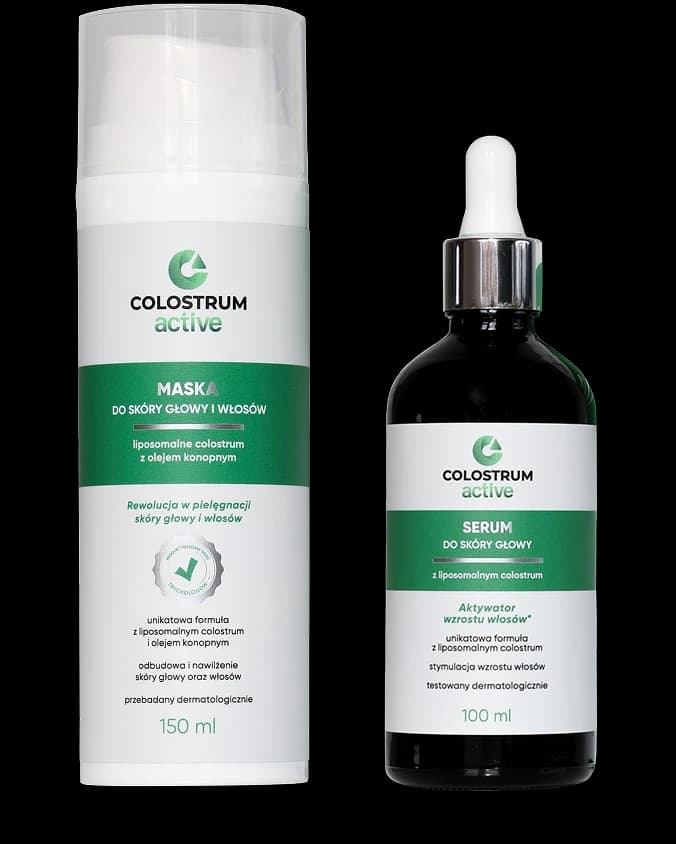
A mask applied to the scalp as well works well in this role: not as a treatment for seborrheic dermatitis, but as a recovery step after washing and after anti-dandruff treatments. Liposomal bovine colostrum, ceramides, hemp oil, and shea butter support the skin's comfort while requiring neither aggressive rubbing nor heavy styling at the roots.

Colostrum Active mask with liposomal colostrum
Intensive regenerating mask.
When to see a specialist
Book an appointment with a dermatologist if you notice redness, oozing, pain, a sudden flare of changes, no improvement despite proper care, changes beyond the scalp, or increased hair loss around the affected areas. A trichologist can help organise your care and tell problems apart, but the diagnosis and treatment of a disease are always led by a doctor.
Frequently asked questions
Is dandruff a fungus? Not quite. Malassezia are yeasts that everyone has on their skin, so dandruff is not a "fungal infection" in the everyday sense. Symptoms are decided by the skin's reaction to these yeasts, not by their mere presence (Cleveland Clinic).
How do I tell dandruff from psoriasis? Dandruff means fine, fairly loose flakes without clear redness. Psoriasis produces thicker, silvery, firmly attached scales on well-demarcated patches, often beyond the scalp and with nail changes. A definite diagnosis is made by a dermatologist (Mayo Clinic).
Can dandruff turn into seborrheic dermatitis? Yes. Greasy dandruff can be a mild form of the same spectrum. If redness and intensified itching join in, that is a signal it is becoming more than a cosmetic problem.
Can seborrheic dermatitis be cured for good? It is a chronic condition, so it is more sensible to talk about control than a cure. Well managed, it can stay quiet for a long time.
Is seborrheic dermatitis contagious? No. Malassezia lives on everyone's skin, and symptoms are decided by an individual reaction, not an infection (Cleveland Clinic).
Does frequent hair washing make dandruff worse? Not in itself. What harms is aggressive washing, or, conversely, washing too rarely. Gentleness and regularity are what count.
Is it caused by poor hygiene? No. This is one of the most damaging misconceptions around this topic.
This article is educational and does not replace medical advice. If in doubt, consult a dermatologist.
Sources
- Borda L.J., Wikramanayake T.C., Seborrheic Dermatitis and Dandruff: A Comprehensive Review, Journal of Clinical and Investigative Dermatology, 2015: pmc.ncbi.nlm.nih.gov
- Cleveland Clinic, Seborrheic Dermatitis: my.clevelandclinic.org
- Mayo Clinic, Scalp psoriasis vs. seborrheic dermatitis: What's the difference?: mayoclinic.org
Educational material. This article is for informational purposes and does not replace consultation with a dermatologist or trichologist. Trichovita is a cosmetic care product — not a medicinal product and not a substitute for medical treatment. If you have a diagnosed scalp condition or persistent hair problems, please consult a specialist.
Discover our products!
We created them with real trichological patient problems in mind.
About the author
Mikolaj Szejnoga
Co-founder, Trichovita
Co-creator of the Trichovita brand, specialist in trichology and cosmetic formulation.
Visit author website