
You buy a serum with an impressive ingredient list. You use it for months. Nothing happens. It is easy to conclude: "this ingredient doesn't work." But the truth is often different: the ingredient never had a chance to work, because it never reached where it was supposed to go.
This is one of the most underrated facts in hair care. A product's effectiveness depends not only on what is in the formula, but on whether that something reaches its target at all. And the target, the cells that decide the condition of the hair, sits a few millimetres below the surface of the scalp.
This article is about delivery. About why most hair products lose most of their potential right at the start, what liposomes are, and why Trichovita's serum and mask are built around solving exactly this problem.
Looking for a short definition + how liposomes are built + their history in medicine? See our ingredient catalog page on liposomes. This article focuses on the question: why does this technology decide the outcome of a trichology product?
The Formula Isn't Everything, Where Most of a Hair Product Disappears
Picture the best possible serum: a rich list of active ingredients, everything a weakened hair could need. You apply it to your scalp. And here the problem begins.
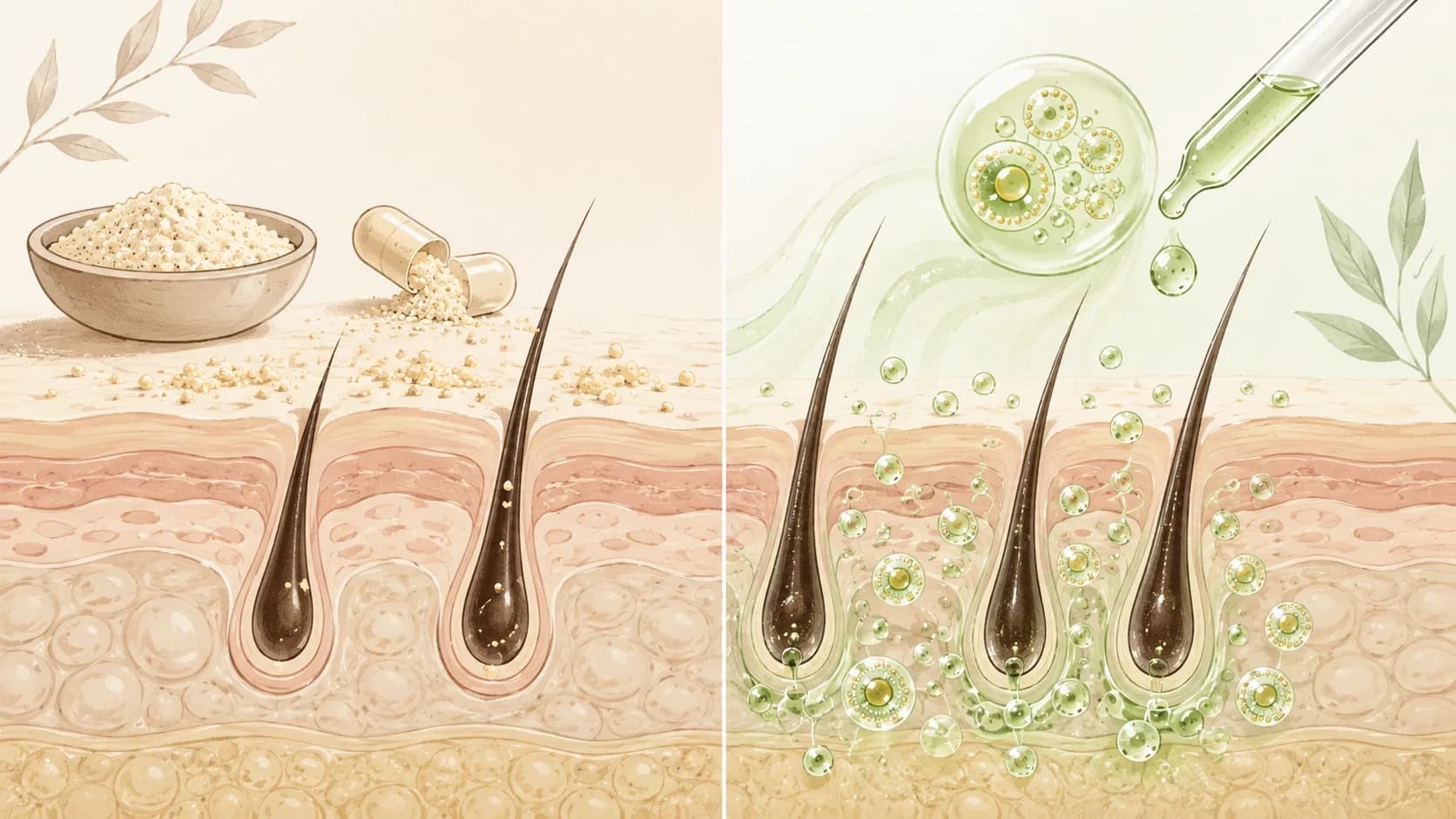
The skin's outer layer, the stratum corneum, is naturally hydrophobic. In plain terms: it repels water-soluble substances. And most hair products are water-based formulas. The result? A large part of the active ingredients simply slides off the surface. They stay on the skin, do not penetrate deeper, and are washed away with shampoo at the next wash.
Meanwhile, the place where those ingredients are meant to work sits 3–4 millimetres below the surface, in the lower part of the hair follicle, by the cells that decide whether a hair grows. For an ordinary water-based formula, that is a distance it cannot cover: very little of it actually gets there, and the rest stays on top doing nothing.
And here a marketing trap appears. "Enriched with keratin!", "with added biotin!", claims about ingredients sound convincing. But an ingredient being present in the bottle is not the same as a dose that actually reaches the follicle. You can add as much active ingredient as you like to a cheap formula, if it does not penetrate, the label claim stays just a claim.
What Liposomes Actually Are
A liposome is a microscopic capsule built from the same lipids that make up the membranes of our own skin cells, mainly phospholipids and cholesterol. Picture a tiny vesicle: inside it carries an active ingredient, and on the outside it has a shell chemically very similar to our own skin. Size? Usually 50–500 nanometres.
The technology is not new. Liposomes were first described in the 1960s and have been used in medicine for decades: to deliver cancer drugs exactly where they are needed, and in vaccines. They appeared in cosmetics much later, and to this day they remain in the minority.
How Liposomes Reach Where an Ordinary Formula Cannot
The whole trick lies in that biomimetic shell.
A liposome's outer layer, a lipid bilayer, is built very much like the cell membranes of the skin. Because of this, the stratum corneum does not repel it. Instead of sliding off, the liposome "negotiates" with the skin barrier and penetrates deeper. When it reaches its target cell, its shell merges with that cell's membrane, and the ingredient lands exactly where it is meant to work.
A second route runs along the hair follicle itself, a natural "channel" in the skin. A study on porcine hair follicles (a model very close to human) showed this directly: liposomes in a suitable formula penetrated to about 70% of the follicle's length, while a conventional formula reached only 30% (Jung et al., 2006). Importantly, the ingredient went selectively into the follicles, barely entering the bloodstream.
These observations are not isolated. Pioneering studies in the 1990s showed under the microscope that liposomes accumulate precisely in hair follicles (Li and Hoffman, 1997). Newer work goes further: ultradeformable liposomes, flexible and able to "squeeze" through the barrier, reach even deeper (Nayak et al., 2024).
| Formula | How much ingredient reaches the follicle |
|---|---|
| Ordinary, water-based | approx. 5–15% |
| Liposomal | approx. 40–70% |
| Ultradeformable liposomes | approx. 60–85% |
A Second, Less Obvious Advantage: the Liposome Protects the Ingredient
Delivery is not everything. The liposome does one more thing that is rarely talked about.
The most valuable ingredients tend to be the most fragile. Growth factors and lactoferrin from colostrum are sensitive proteins: to oxidation, pH changes, enzymes. In an ordinary water-based formula they begin to break down within hours or days of opening the product. In other words: you buy a serum with growth factors, and after a few weeks only a fraction of them remains in the bottle.
Enclosing the ingredient in a liposome changes that. The shell isolates it from oxygen, pH and enzymes, the ingredient stays active much longer and retains full bioavailability the moment it reaches the skin. That is why liposomes make particular sense where the ingredient is delicate and expensive. With colostrum, a natural, rich, but fragile concentrate, it is practically a precondition for the investment in the raw material to make sense.
Why So Few Hair Products Use a Liposomal Formula
If liposomes work, why are they not the standard? The answer is mundane: money.
Creating a stable liposomal formula requires specialist equipment, quality control, and raw materials several times more expensive than in water-based formulas. For a mass-market brand the calculation is simple: it is cheaper to dump a higher dose of an ingredient into a cheap formula and print it in large type, than to invest in the ingredient actually reaching its target.
That works, but in marketing communication, not on the skin. A high number on the label sells the product. Ingredient delivery sells worse, because it is invisible and harder to capture in a single slogan. That is why most trichological cosmetics still rely on formulas that work on the surface. A liposomal formula is a deliberate decision, and a cost not every brand is willing to bear.
Trichovita's Serum and Mask, the Same Technology, Two Uses
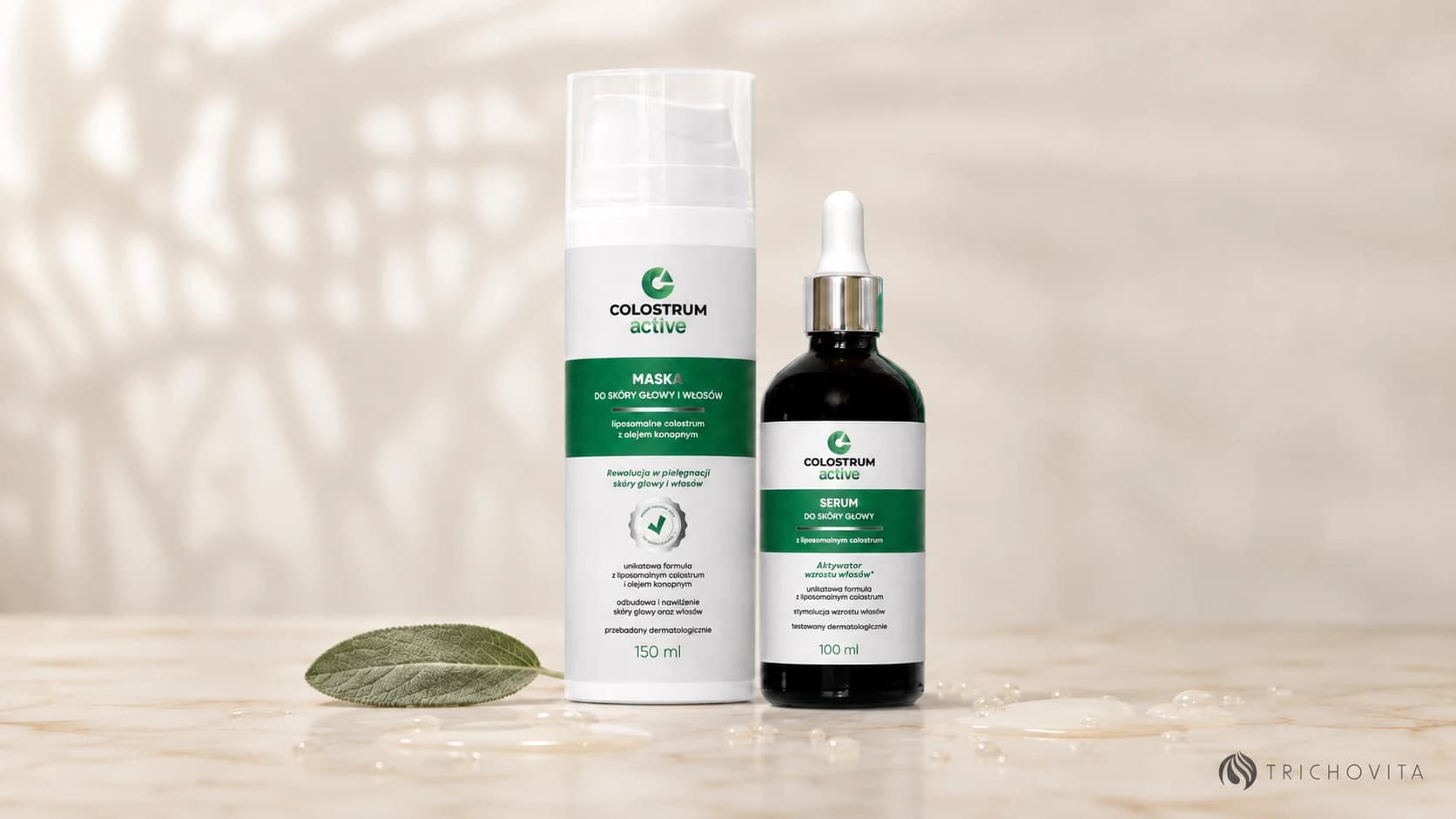
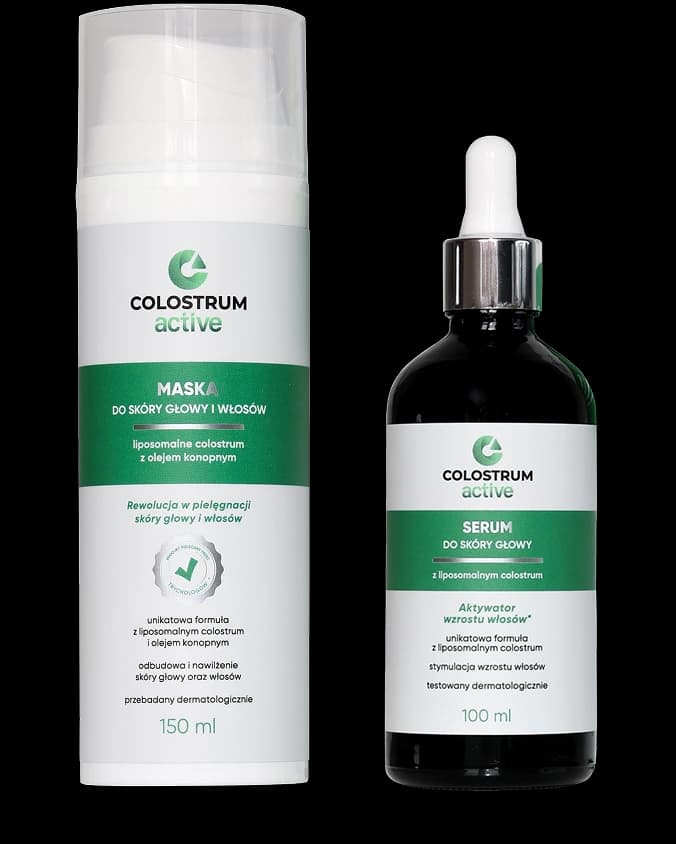
Liposomes are the foundation of both of Trichovita's products. In the serum and in the mask, bovine colostrum, together with growth factors and lactoferrin, is enclosed in liposomes. Trichovita is currently the only trichological line in Poland with liposomal colostrum. That is not an advertising slogan, but a specific technological decision.
So why two products, if the technology is the same? Because they differ in how they contact the skin.
The serum (100 ml) is a product for daily, morning and evening (2× a day), leave-in use. You apply it to the scalp and it stays there for many hours. Its role is calm, everyday work, delivering ingredients and supporting the skin barrier. Besides colostrum, it contains a complex of ceramides (NP, AP, EOP) with phytosphingosine and cholesterol, plus hydrolysed silk.
The mask (150 ml) is an intensive treatment, 1–2 times a week. You apply it for at least 15 minutes, or, for the best results, overnight, per the trichologist's recommendation. Rinse with warm water after 15 minutes, or with shampoo in the morning if left overnight. It combines liposomal colostrum with four botanical oils: jojoba, hemp, sweet almond and shea butter.
| Serum | Mask | |
|---|---|---|
| How often | daily, morning and evening | 1–2× a week |
| Rinsing | no (leave-in) | yes, after 15 min or in the morning |
| Skin contact | many hours | 15 min – overnight |
| Role | daily support and barrier | intensive treatment |
The two products are designed to complement each other, a daily base plus a regular treatment. And liposomal technology is the common denominator: in both cases it is what ensures the ingredients actually reach the scalp, rather than staying on its surface.
Colostrum Active: Bundle Serum + Regenerating Mask
A complete set for scalp and hair regeneration.
What Liposomes Will NOT Do, Honestly
Since there has been so much here about the advantages, the other side is due.
A liposome is a delivery technology, not a miracle ingredient. It makes the ingredient reach its destination, but it does not change what that ingredient can do. It delivers it in full, nothing more.
Second: a cosmetic with liposomal colostrum is supportive care, not a medicine. It will not cure androgenetic alopecia, and it will not replace dermatological treatment for a diagnosed scalp condition. With serious, progressive hair loss, the first step is a specialist, the cosmetic is one element of care, not a substitute for a diagnosis.
And third: time. Delivery itself works immediately: liposomes penetrate the skin within minutes. But the biological effect depends on the ingredient and needs its own time. Realistically, the first effects of regular use are visible after 4–6 weeks, with consistency, not after a single use.
Frequently Asked Questions
Is a liposomal formula safe?
Yes. Liposomes are built from natural phospholipids, the same ones that make up our cell membranes. They have been used in medicine for decades, including in drugs and vaccines. In a cosmetic they do not cause allergic reactions more often than ordinary formulas, rather less often, because effective delivery allows lower concentrations of active ingredients.
Are liposomes the same as "nanotechnology"?
Technically, liposomes (50–500 nm) fall within the nano scale, but they have nothing in common with controversial nanoparticles such as nanosilver or titanium dioxide. They are natural lipid vesicles, not synthetic structures.
How does the serum differ from the mask?
The serum is used daily and not rinsed off (leave-in), it works for many hours a day. The mask is a treatment 1–2 times a week: about fifteen minutes, then you rinse it off, but at a higher concentration. The serum is the daily base, the mask a regular boost. They work best together.
How soon are results visible?
Delivery itself is immediate. The biological effect depends on the ingredient: the skin barrier responds within days, hair condition within weeks. As a rough guide, the first visible effects appear after 4–6 weeks of regular use.
Is a liposomal serum for everyone?
Liposomes are a delivery technology, so in a sense they are "for anyone who cares about effectiveness." They are especially worth considering if you use other trichological cosmetics and see no effect, it is possible the problem is not in the formula, but in the fact that the ingredients do not reach their target.
Do liposomes work better than an "ordinary" serum?
It is not liposomes that "work", the active ingredients do. Liposomes ensure those ingredients reach where they are meant to work at all, and protect them from breaking down. An excellent formula in a product that does not deliver it uses only a fraction of its potential.
Summary
An ingredient list is only half the story of a cosmetic. The other half, often the more important one, is the question of whether those ingredients reach where they are meant to work at all.
Most hair products lose precisely this second half: their ingredients stay on the surface of the skin. Liposomes are the answer to this problem, biomimetic capsules that carry ingredients deep into the scalp and protect them along the way. It is a proven technology, not a marketing gimmick.
Trichovita's serum and mask are built around this principle: what matters is not only what is in the formula, but that this something actually reaches the follicle. If you want to understand what colostrum itself holds, we have gathered a review of the research on bovine colostrum.
References
This article is based on peer-reviewed scientific publications:
- Jung S, Otberg N, et al. (2006). Innovative liposomes as a transfollicular drug delivery system: penetration into porcine hair follicles. Journal of Investigative Dermatology 126(8):1728–1732. DOI: 10.1038/sj.jid.5700323
- Li L, Hoffman RM (1997). Topical liposome delivery of molecules to hair follicles in mice. Journal of Investigative Dermatology. PubMed
- Nayak D, et al. (2024). Ultradeformable Liposomes for Follicular Delivery. PMC11595114
Educational material. This article is for informational purposes and does not replace consultation with a dermatologist or trichologist. Trichovita is a cosmetic care product — not a medicinal product and not a substitute for medical treatment. If you have a diagnosed scalp condition or persistent hair problems, please consult a specialist.
Discover our products!
We created them with real trichological patient problems in mind.

About the author
Mikolaj Szejnoga
Co-founder of Trichovita
Co-creator of the Trichovita brand, specialist in trichology and cosmetic formulation.
Visit author website